TEST BED 2 (TB2) – WATER ENGINEERING LABORATORY, UNIVERSITY OF PERUGIA (UNIPG)
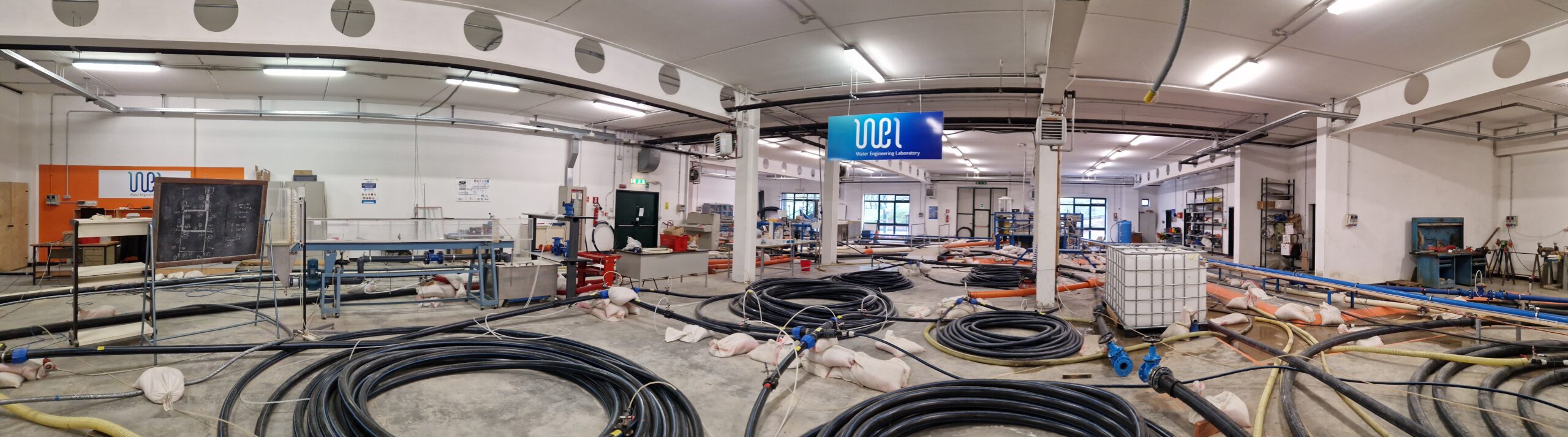
TB2, hosted at the Water Engineering Laboratory (WEL) of the University of Perugia, is coordinated by UNIPG team within Work Packages 4 and 5 of the MORE4WATER project.
This testbed is dedicated to analyzing the dynamic behavior of water distribution networks, with a special focus on the performance of pressure control devices under variable operating conditions.
The WEL is a cutting-edge experimental facility, originally established in June 1997 for educational, research, and consultancy purposes in the field of hydraulics and water systems.
It covers an indoor area of approximately 870 m2 and an outdoor space of 160 m2. The laboratory includes a versatile water supply and recycling system featuring:
– a pressurized tank;
– five pumps;
– a storage tank;
– over 1 km of pipelines with various diameters and materials, arranged in multiple, reconfigurable hydraulic circuits.
Thanks to the “Dipartimenti di Eccellenza 2018–2022” program, the laboratory was recently renovated and significantly upgraded. The new setup was inaugurated during a public ceremony held on June 21, 2021.
To test the WSN, modelling the actual functioning conditions, studying the optimal pressure control, and detecting faults in WDNs, different experimental setups at WEL are considered.
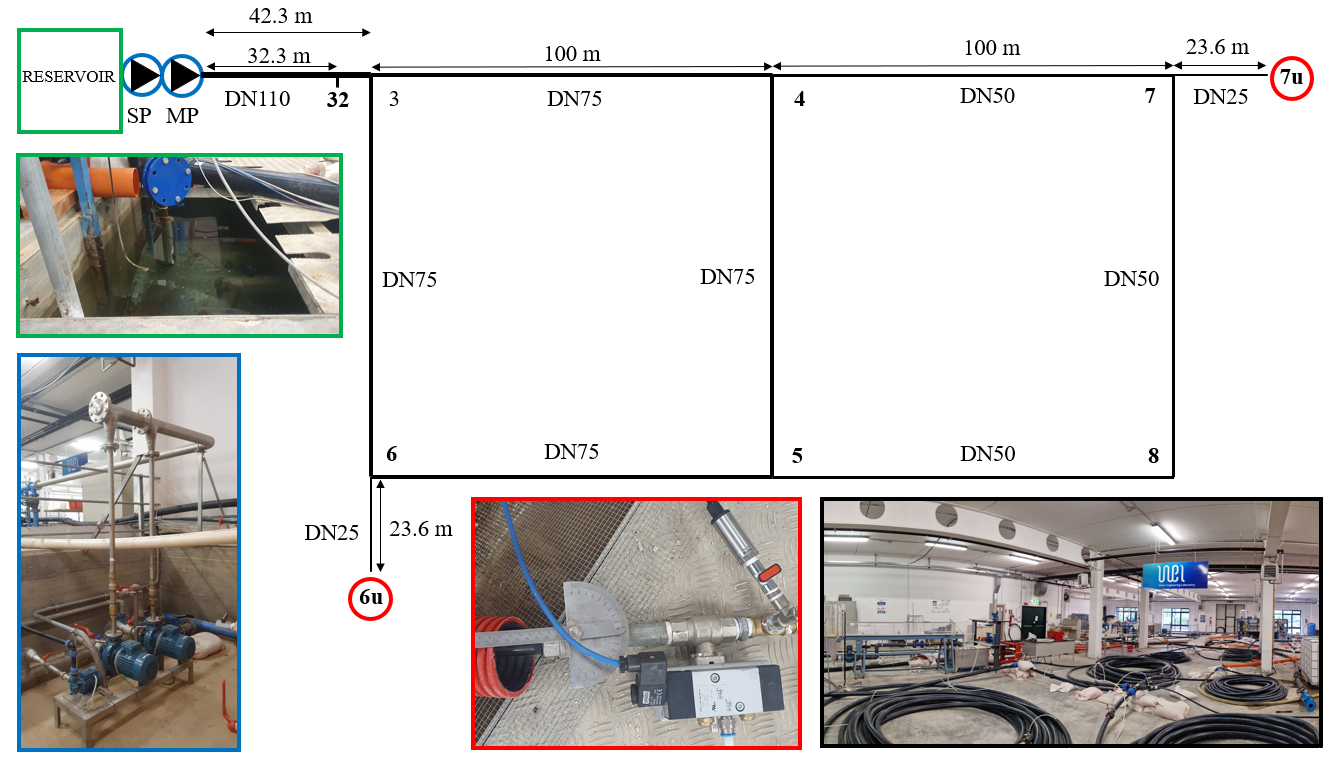
One of the experimental setup consists of a water distribution network (WDN) with all pipes made of high-density polyethylene (HDPE). The WDN includes a DN110 supply line, 42.30 meters in length, with an internal diameter of D = 93.3 mm and wall thickness e = 8.1 mm, along with two loops. The first loop is composed of four DN75 pipes, each 100 meters long, with D = 63.8 mm and e = 5.6 mm. The second loop shares one pipe with the first loop, and the remaining three are DN50 pipes, each 100 meters long, with D = 42.6 mm and e = 3.7 mm. DN25 service lines (SLs), 23.60 meters long, with D = 20 mm and e = 3 mm, can be installed at section 5, 6, and 7. At the downstream end of the SL, a ball valve is installed to regulate flow and simulate end-user maneuvers.
The WDN can be supplied by a pressurized tank or directly by two identical pumps arranged in series: the supply pump (SP) and the maneuver pump (MP), as in the figure.ㅤㅤㅤㅤㅤㅤㅤㅤㅤㅤㅤㅤㅤㅤㅤㅤㅤㅤㅤㅤㅤㅤㅤㅤㅤㅤㅤㅤㅤㅤㅤㅤㅤㅤㅤㅤㅤㅤㅤㅤㅤㅤㅤㅤㅤㅤㅤㅤㅤㅤㅤㅤㅤㅤㅤㅤ
Cllick HERE for more details about the WEL.
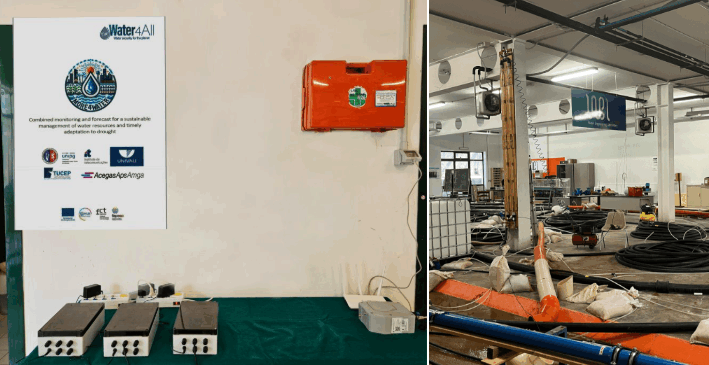
On June 6, 2025, the Wireless Sensor Network (WSN) developed within WP1 – Monitoring with Smart and Distributed Sensors was successfully installed and activated at our second testbed (TB2) in Perugia, Italy, at the Water Engineering Laboratory of Università degli Studi di Perugia.
This follows the earlier installation and activation of the WSN at our first testbed (TB1) in Lisbon, Portugal, over the past months, led by Instituto de Telecomunicações (IT), Instituto Superior Técnico.
The WSN is designed to monitor groundwater and lake levels, as well as urban water supply and irrigation systems in real-time. Its architecture supports smart, distributed data collection, enabling efficient and sustainable water resource management.
At TB2, two LoRa nodes are currently acquiring pressure and flow data from key points in the hydraulic test network.
This marks a key step toward energy-efficient, scalable, and data-driven water system monitoring.